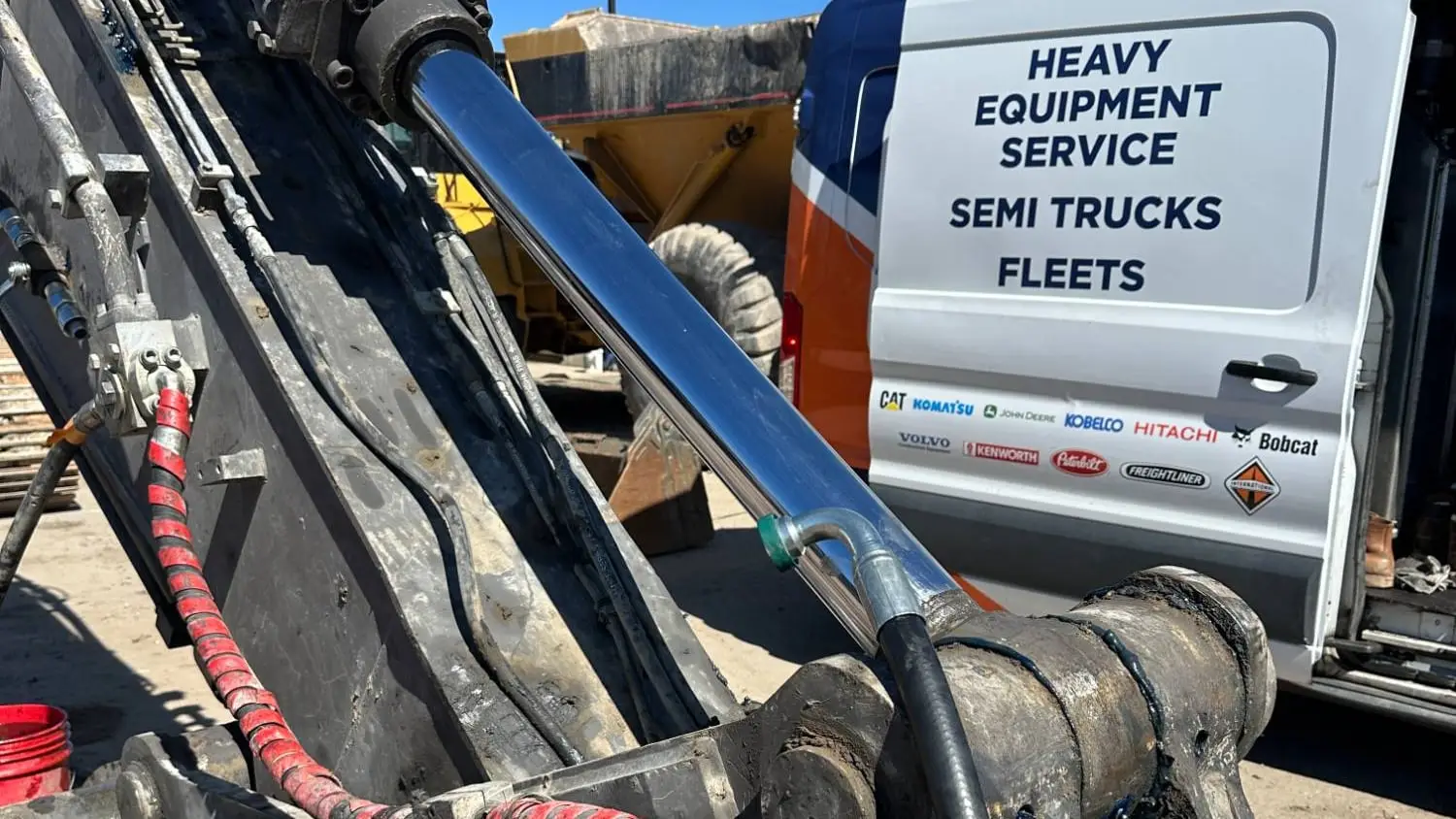
Hydraulic Hose Repair
Can You Repair a Hydraulic Hose, or Does It Need to Be Replaced?
Can you repair a hydraulic hose? On heavy equipment, no. A damaged hose gets replaced with a new hose assembly, built to the right length and pressure rating with new fittings crimped on. The 2021 revision of SAE J1273, the industry’s recommended practices for hydraulic hose assemblies, removed the option of repairing hose assemblies in the field.
That doesn’t stop people from trying: patch the split, splice in a new section, cut off the bad end. Here’s why those fixes don’t hold, what the right fix is, and how to tell when a leak isn’t the hose at all.
Repair vs. replace: the fixes people try, and why they don’t hold
Tape, clamps and wraps
Electrical tape, hose clamps, rubber wraps and “hose repair” tape are common quick fixes. On a high-pressure hydraulic line, none of them hold. At best they slow a leak. At worst they hide a hose that’s about to separate, with someone standing right next to it.
They also don’t solve the bigger safety problem. A pinhole leak under pressure can inject fluid through skin, and a wrapped hose can still do that.
Can you splice a hydraulic hose?
Splice kits and hose menders join two pieces of hose with a fitting in the middle. It sounds like a clean fix, but:
- It adds two more connections to a line that has already failed once.
- It’s still a field repair of a hose assembly, the option SAE J1273’s 2021 revision removed.
- The damaged area is often bigger than it looks. Heat, abrasion or age that killed one spot has usually weakened the hose around it too.
On heavy equipment, a spliced pressure line is a breakdown waiting to happen.
Cutting off the bad end and re-ending the hose
If a hose fails right at one end, it’s tempting to cut it back and put a new end on. Two problems:
- The hose is now shorter. A hose that’s too short gets pulled tight, routed wrong, or bent past its minimum bend radius. That shortens its life and can loosen the fitting.
- The rest of the hose is still old. If it failed from age or heat, the remaining length isn’t far behind.
Putting the old fitting back on
Crimped fittings are permanent. Once a crimped fitting is cut off a hose, it can’t be reused. Field-attachable (reusable) fittings exist, but they have lower pressure capability than crimped fittings. Industry guidance also favors new parts over reused ones, and warns against putting one manufacturer’s fittings on another manufacturer’s hose.
Why a new assembly is the right fix
A new hose assembly fixes the problem instead of hiding it:
- The hose and fittings work together. Crimped fittings are made to match the hose they go on and are crimped to the manufacturer’s spec, which is what gives the assembly its pressure rating and resistance to pulling off.
- It’s the right length. The new hose matches the original routing, so it isn’t stretched, kinked or rubbing.
- It’s all new. No old hose left over to fail next week.
On heavy equipment, that’s the fix that lets the crew get back to work and stay working.
Sometimes it isn’t the hose
Where the leak is coming from matters:
- At the crimp, the ferrule, or anywhere in the hose itself: the hose assembly gets replaced. That’s a replace-now condition, not something to tighten and forget.
- Where the fitting connects to the machine: the cause can be something else, like a worn O-ring or a damaged adapter.
That’s why on every hose call we identify the source of the leak and confirm whether it’s hose-related, then pinpoint the exact line. If it isn’t the hose, we’ll tell you what we found. Either way, never feel for a leak with your hand. Shut the machine down and look with a flashlight.
One failed hose? Check its neighbors
Hoses on the same machine are often the same age and see the same heat, abrasion and pressure cycles. Machines that work through Utah’s cold winters and hot, dusty summers put their hoses through all of it. If one hose failed from age, the others nearby may not be far behind. With the machine shut down and pressure relieved, check them for the warning signs of a failing hose.
For fleets, we offer scheduled hose inspections and proactive replacement, so high-risk hoses get swapped on your schedule instead of mid-shift.
We replace hoses on-site in Utah County and Salt Lake County
When a hose needs replacing, we build the new one right at your machine. Our hose truck carries a hose crimper, common hose sizes and a wide variety of fittings, so there’s no towing and no waiting on a shop. Most repairs are done in one visit, and we pressure test the system before we leave.
Most daytime calls in Utah County and the south end of Salt Lake County are on-site within an hour, and 24/7 emergency service is available for blown hoses. Learn more about our mobile hydraulic hose repair, see how it compares to hauling a machine to a shop, or find your area: Lehi, Orem, Provo, Draper and all service areas.
Call or text 801-330-5591, or use our contact page. If a hose just blew, here’s what to do in the first 10 minutes and what happens when you call for emergency hose repair.
Sources: SAE J1273, Recommended Practices for Hydraulic Hose Assemblies, including the 2021 revision to Section 6.6 that removed the option of repairing hose assemblies in the field, as summarized by ANSI; Crimp Fittings vs. Field Attachable Hose Ends (Kimball Midwest); Are field-attachable fittings truly reusable? (Hose Assembly Tips).