Hydraulic Hose Repair
24/7 Emergency Hydraulic Hose Repair: What Happens When You Call
Hoses don’t wait for business hours. They blow on a Saturday pour, on the night shift, and at 5:45 on a Friday when the last load still has to go out. That’s why emergency hydraulic hose repair has to be available 24 hours a day.
If you’ve never called a mobile hose service before, here’s exactly what happens, from the first call to the machine going back to work, plus a few things you can do now so the next failure costs you less time.
What counts as a hydraulic hose emergency?
A hydraulic hose emergency is a sudden hose failure that causes fluid loss, a pressure drop, or an equipment shutdown that keeps the machine from working. That includes:
- A blown or split hose spraying or dumping oil
- A hose pulled out of its fitting
- A steady leak that’s dropping the hydraulic oil level, or puts oil near hot engine parts
- A machine that suddenly won’t lift, steer or travel after a loud pop or a puff of oil mist
Any leak deserves attention. A pinhole leak under pressure can inject fluid through skin, and a weeping hose can fail at any time. A scuffed or weathered cover with no leak is better handled with a scheduled hose replacement before it turns into a blowout. If you’re not sure, shut the machine down and call. We’ll help you decide.
Step 1: You call or text
Call or text 801-330-5591. Day or night, you reach us directly, not an answering service that takes a message and calls back tomorrow.
Before you call, make sure the machine is shut down and everyone is clear of it. Never use your hand to feel for a leak. A pinhole leak under pressure can inject fluid through skin, and that’s a medical emergency. If you haven’t done that yet, start with our guide on what to do in the first 10 minutes after a hose blows.
Step 2: We ask a few quick questions
To get the right hose built fast, we’ll ask:
- Where is the machine? An address, cross streets or a location pin, plus where it’s parked on the site.
- What machine is it? Make and model, or a photo of the serial plate.
- Which hose failed? Where it runs on the machine, and what the machine was doing when it let go.
- Is it shut down and safe? Attachments on the ground, engine off, no one near the leak.
The fastest way to answer most of this is to text photos: both ends of the failed hose, where it runs on the machine, and the machine itself.
Step 3: We head your way
We work across Utah County and Salt Lake County, from Lehi, Saratoga Springs and Eagle Mountain down to Provo, Springville and Spanish Fork, and north to Draper and Bluffdale.
- Daytime: most calls in Utah County and the south end of Salt Lake County are on-site within an hour, and most other Salt Lake County calls within 2 hours.
- Nights, weekends and holidays: emergency service is available 24/7.
Step 4: We confirm it’s the hose
When we get there, we verify the leak is hose-related and pinpoint the exact line. Sometimes what looks like a hose leak is a fitting, an adapter, or something else on the machine. We’d rather find that out before building anything.
Step 5: We build and install the new hose on-site
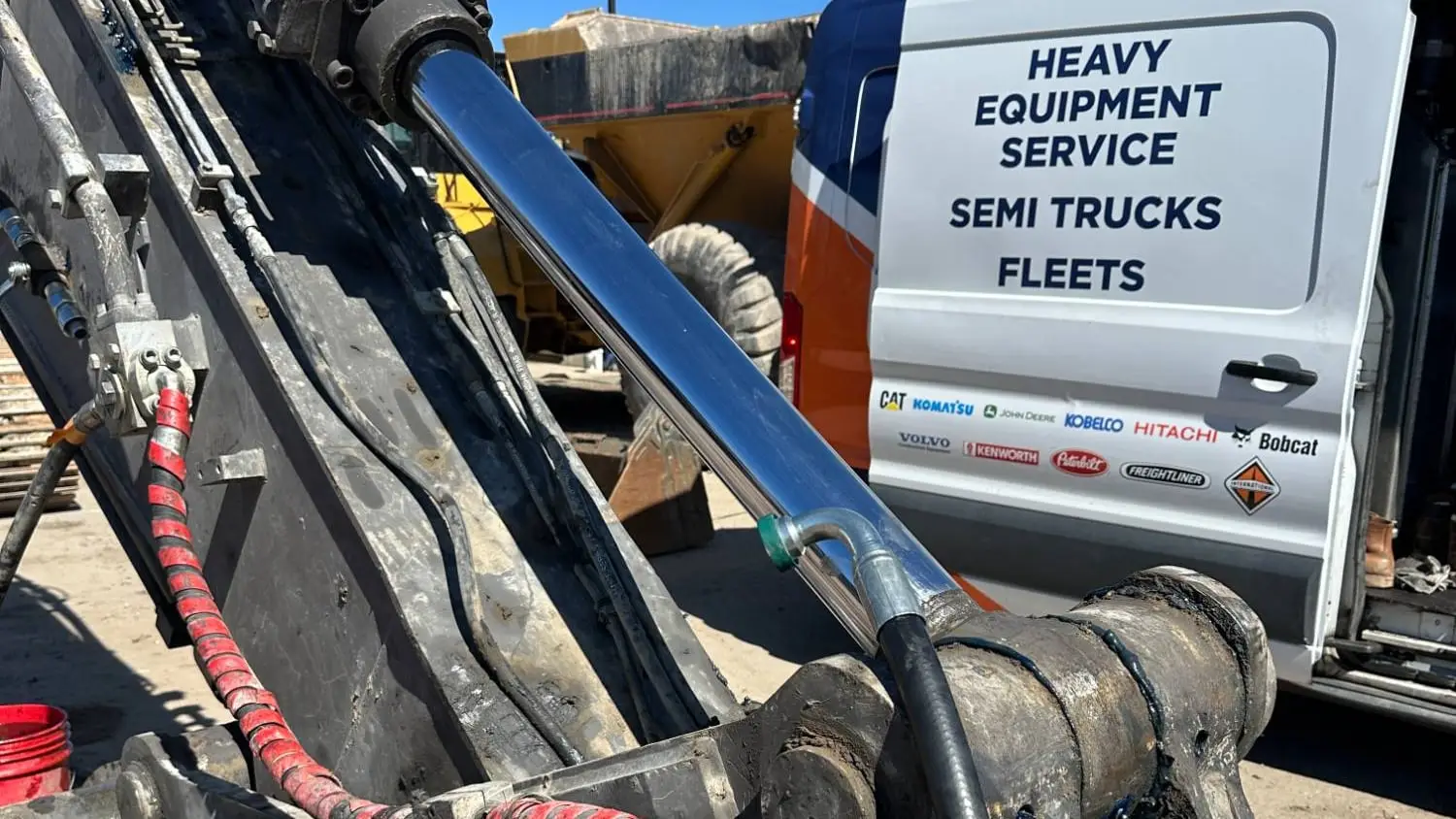
Our hose truck carries a hose crimper, common hose sizes and a wide variety of fittings. We remove the damaged hose, build the new one on the truck, cut to length and crimped with the right fittings for your machine, and install it.
There’s no towing and no waiting on a shop. Most repairs are done in one visit.
Step 6: We test it before we leave
We pressure test the system to make sure everything is working and the leak is gone. Then the machine goes back to work.
How to be ready before the next failure
A few minutes of prep now saves real time when a hose lets go at a bad moment:
- Save our number in every operator’s phone. 801-330-5591, under something easy like “Hose Repair.”
- Keep a spill kit on the machine or in the pickup. Absorbent pads and a drain pan keep a hose failure from turning into a bigger cleanup.
- Keep a list of your machines. Make, model and serial number for each one, so whoever calls can answer fast.
- Do a hose walkaround every day. Hoses often give warning signs before they blow. Here are 7 signs a hydraulic hose is about to fail.
- Fix repeat failures, not just the hose. If the same hose keeps failing, ask about the routing and clamping when it’s replaced.
For fleets, the best emergency call is the one you never have to make. We also offer scheduled hose inspections and proactive replacement, so high-risk hoses get swapped on your schedule instead of mid-shift.
24 hour hydraulic hose repair in Utah County and Salt Lake County
When a hose blows, the fastest fix is the one that comes to you. We provide 24/7 emergency hydraulic hose repair for excavators, loaders, skid steers, dozers, semis and more, built and crimped right at your machine. Wondering whether to haul the machine in instead? Here’s how mobile hose repair compares to the shop.
Find your area: Saratoga Springs, Eagle Mountain, Pleasant Grove, Vineyard, Springville, Bluffdale and all service areas.
Call or text 801-330-5591 any time, or use our contact page.
Sources: SAE J1273, Recommended Practices for Hydraulic Hose Assemblies, as summarized by ANSI; 6 tips for safe and effective hose maintenance (Hose Assembly Tips), which lists the replace-immediately conditions and the never-feel-for-leaks rule.